
Short answer: do reviews affect SEO and AI answers?
Yes, though the effect is not the same everywhere. Google says more reviews and positive ratings can help a business's local ranking, so the strongest effect is in Maps. Review text, and the platforms where reviews are posted, shape how ChatGPT, Perplexity and Google's AI answers describe and recommend a business. In classic organic results the effect is indirect: it works through clicks, brand searches and content.
A customer checks four places before calling you, and reviews feed all four. I'm Dmitrii Dmitriev, and I have worked in digital marketing since 2008. Below I separate what Google confirms from what practitioners observe and from what is plain myth. You get a map of the signals, rules by region (US, UAE, EU/UK) and a 90-day plan you can measure.
The four places customers check you, and what reviews do in each
Reviews do the most in Maps and a lot in AI answers. They also help in Ads, but they affect organic search only indirectly. The table shows where the evidence is solid.
| Place | What reviews influence | Strength of evidence | Main lever |
|---|---|---|---|
| Google Search (organic) | Brand searches, clicks, third-party review pages ranking for your name | Observed, indirect | Strong profiles on platforms that rank for “[brand] reviews” |
| AI answers: ChatGPT, Perplexity, AI Overviews, AI Mode | Source material and the attributes used to describe you (“fast response”, “pricey but reliable”) | Observed | Specific, consistent review text on platforms AI engines can retrieve |
| Maps and Google Business Profile | Local ranking through prominence, plus conversion | Confirmed | Review count, score and a steady flow |
| Google Ads | Ad appearance and click-through rate | Confirmed as a feature | Seller ratings, location assets |
Google mostly stopped showing star snippets for local businesses' reviews of themselves on their own sites (see the schema section). The four-places approach is explained on the 4Queries homepage.
What Google confirms about reviews and local ranking, and what is only correlation
Confirmed in Google's own documentation
Google's Business Profile help page “Tips to improve your local ranking on Google” says local results are mainly based on relevance, distance and popularity, and explains the last one under the heading Prominence: how well known a business is, based partly on links and on how many reviews it has. It then says: “More reviews and positive ratings can help your business's local ranking.” The same page recommends responding to reviews. Google does not publish how much weight reviews carry.

Observed by practitioners, not confirmed
Industry surveys such as the Whitespark Local Search Ranking Factors survey, along with practitioner tests, point to two patterns. First, query terms in review text seem to correlate with Map Pack visibility for that query. Second, recent reviews seem to count for more than the lifetime total. Treat both as observations, not documented facts.
Correlation studies can mislead. Businesses with many reviews are usually older, bigger and better linked, so their reviews may be a result of their strength rather than the cause of it.
Myths worth dropping
- Every new review moves you up one position.
- Keywords in your replies boost rankings.
- You need exactly X reviews.
In my experience, review work clearly moved rankings when a business was far behind the pack on recent reviews and then closed that gap. It did little when the business was too far from searchers or had the wrong primary category. In those cases distance and relevance decided the result.
Review signals that matter: rating, volume, recency, velocity, text, responses
Six review signals matter, and each affects different things: ranking, click-through, AI descriptions or conversion. Google confirms that more reviews and positive ratings can help local ranking. The rest is observation.
Rating: why 4.9 can beat 5.0 for conversion
Rating affects conversion first. Buyers do not insist on perfection: in BrightLocal's 2026 survey of US consumers, only 10% said they would use only businesses with a five-star rating, while 47% said they would not use a business with fewer than 20 reviews. In our experience, a 4.8 or 4.9 from many reviews often looks more believable than a perfect 5.0 from a dozen. My judgment: once your rating looks credible, volume and recency compared with the businesses that rank tend to do more for visibility. Below 4.0, the rating itself becomes the first problem to fix: in the same survey, 68% said they would only use a business with four or more stars.
Volume: relative to competitors in your area, not absolute
There is no fixed number of reviews you need. Look at the three businesses in the Map Pack for your main query and neighborhood, and aim to match how many reviews they got in the last 12 months, not their lifetime total.
Recency and velocity: a steady flow beats a burst
A steady flow looks natural to Google and to buyers. A burst followed by silence looks like a campaign.
Review text: services, places and attributes customers mention
Reviews that name the service, the neighborhood and an attribute (“fixed price”, “came on Sunday”) give Google and AI engines words to match against searches.
Owner responses: conversion signal first, ranking signal at most a weak one
Benchmark with a simple sheet: competitor, total reviews, reviews in the last 90 days, rating and share of reviews answered. Update it monthly.
How AI answer engines use reviews
Where ChatGPT, Perplexity and Google AI answers get review information
No AI assistant documents whether it reads Google reviews directly. OpenAI says ChatGPT gets local business information through third-party search providers and data partners, and a 2026 BrightLocal study found Yelp was ChatGPT's most cited source for local businesses. Perplexity runs its own crawler and search index. In practice, both cite pages they can retrieve: review platforms such as Yelp, Tripadvisor and Trustpilot, directories, “best X in city” lists, Reddit and news. Google's AI Overviews and AI Mode can draw on Google's own local and Maps data; in the same study, Business Profile was their main source for local businesses. Sources change over time, so test what each engine cites instead of assuming.
Reviews as entity attributes: how a business gets described
The model summarizes what many sources repeat. If reviews across platforms keep saying “same-day repair” or “speaks Arabic and English”, that phrase tends to become your description in the answer. The path runs from a review on a platform, to a page the AI engine retrieves, to an attribute in the answer.
Why AI recommended a competitor with fewer reviews
Review count is only one input. The competitor may appear on more of the sources the engine retrieves, describe its category and services more clearly, be named in lists and comparison pages, or have reviews that match the attribute in the prompt.
The full method is on our AEO page. You can check your own business with the free AI visibility checklist.
Beyond Google: which review platforms matter in the US, UAE and Europe
Google is the primary platform in all three regions. On top of that, one or two secondary platforms are worth active effort, chosen by region and vertical. |
| Region | Active effort | Claim and monitor only | Notes by vertical |
|---|---|---|---|
| United States | Google; Yelp profile and replies (Yelp asks businesses not to request reviews) | BBB, Facebook | Home services: Angi, Houzz. Clinics: Healthgrades, Zocdoc. B2B: Clutch, G2. |
| UAE | Facebook, Instagram, vertical portals | Hospitality and tourism: Tripadvisor. Clinics and real estate: the vertical platforms local AI answers actually cite. Expect reviews in both Arabic and English. | |
| Europe and the UK | Google, Trustpilot (strong in the UK, the Nordics and DACH) | ProvenExpert, Kununu (Germany, employer reviews) | Hospitality: Tripadvisor. B2B: Clutch, G2 and country directories. |
Do Yelp, Trustpilot or Clutch matter if most customers find you on Google? For Maps, not much. For AI answers and brand searches, they often do, because those pages rank for “[brand] reviews” and AI engines can retrieve them easily. A good rule: Google plus 1-2 secondary platforms, chosen after checking what ranks for your brand's reviews and what AI answers cite.
Review text as content: how customer wording shapes rankings and AI descriptions
What 'keywords in reviews' really means
It means customers describing the job in their own words: the service, the place and the outcome. Google can surface this text in Maps as Place Topics and review snippets, which highlight common themes and the words customers mention most.
How to prompt for detail without scripting customers
You can ask for an honest, specific review. Telling customers which words to use, or writing reviews for them, breaks platform policies and in some regions consumer law. Ask an open question instead: “What did we help you with, and how did it go?”
Mine reviews, both yours and your competitors', for the language customers actually use. Then put that language, in your own words, on your service pages and in your Business Profile description. This is where review work meets on-page SEO.
An illustrative example, not a client: a dental clinic whose reviews keep mentioning “nervous patients” may find that AI answers start describing it as good for anxious patients.
Responding to reviews: what helps, what wastes time
Does replying improve rankings or only conversions?
Google recommends replying, and the proven benefit is trust and conversion. Any ranking effect is unproven and small at best. Keyword-stuffed replies are a waste of time and look spammy, and so are copy-paste thank-yous, long apologies and bulk replies to three-year-old reviews.
Reply frameworks that don't read like templates
For a positive review, name the specific job, add one fact the reader can use and sign with a real name. For a mixed review, acknowledge the specific point, say what changed and offer a direct contact.
- Home service: “Glad the water heater swap went smoothly, Mark. The warranty is registered to your address, so just call if anything comes up. Ana, service manager”
- Clinic: “Thank you for raising the wait time. We now space out morning appointments to cut delays. If you'd like to talk it through, call me directly. Dr. Hale”
- B2B agency: “Thanks for the kind words on the migration. The documentation is yours to keep, and we're happy to review it with you next quarter. Sara, project lead”
Pick one named person to reply within 1-2 business days and log replies in the benchmark sheet.
Negative reviews: when they hurt, when they help, how to handle them
When negative reviews hurt
They hurt when recent ones cluster, when the same complaint repeats, when they go unanswered, or when your average falls below the businesses in the pack.
Why a few critical reviews can help
A perfect 5.0 on a small count looks curated. A calm public reply shows buyers how you handle problems.
Removing and reporting: what Google actually takes down
Google removes reviews that break its prohibited and restricted content policy: spam, conflict of interest, off-topic content, harassment and personal information. It does not remove a review because it is negative or unfair. Flag the review from your profile, then use Google's review management tool to track its status or appeal. If you face review bombing or extortion, document everything, report it through official channels and don't argue in public. Never offer a refund in exchange for deleting a review, and never post counter-reviews.
Getting more reviews the right way: timing, direct links, process over campaigns
When to ask
Ask at the moment the customer gets value: when the job is finished or the result is delivered. Don't wait for the invoice weeks later.
How to ask
Use the direct review link from your Business Profile, a QR code at the counter or in the van, and SMS or WhatsApp (the default channel in the UAE), not email alone. Ask every customer, not only the happy ones. The exception is Yelp, which asks businesses not to request reviews at all, so keep it out of your request routine.
Building it into operations
Name an owner, set a trigger in your CRM or booking system and count reviews every week. Practitioners see sudden unnatural bursts, especially from new accounts or a single location, get reviews filtered or profiles restricted. Google's policy prohibits fake engagement, and Google has said it may show warnings on profiles where it finds fake reviews. Reviews usually go live within days once they pass moderation. Effects on rankings and AI answers build over weeks to months, and not evenly.
What not to do: gating, incentives, fake reviews and the rules by region
Platform rules (Google, Yelp, Trustpilot)
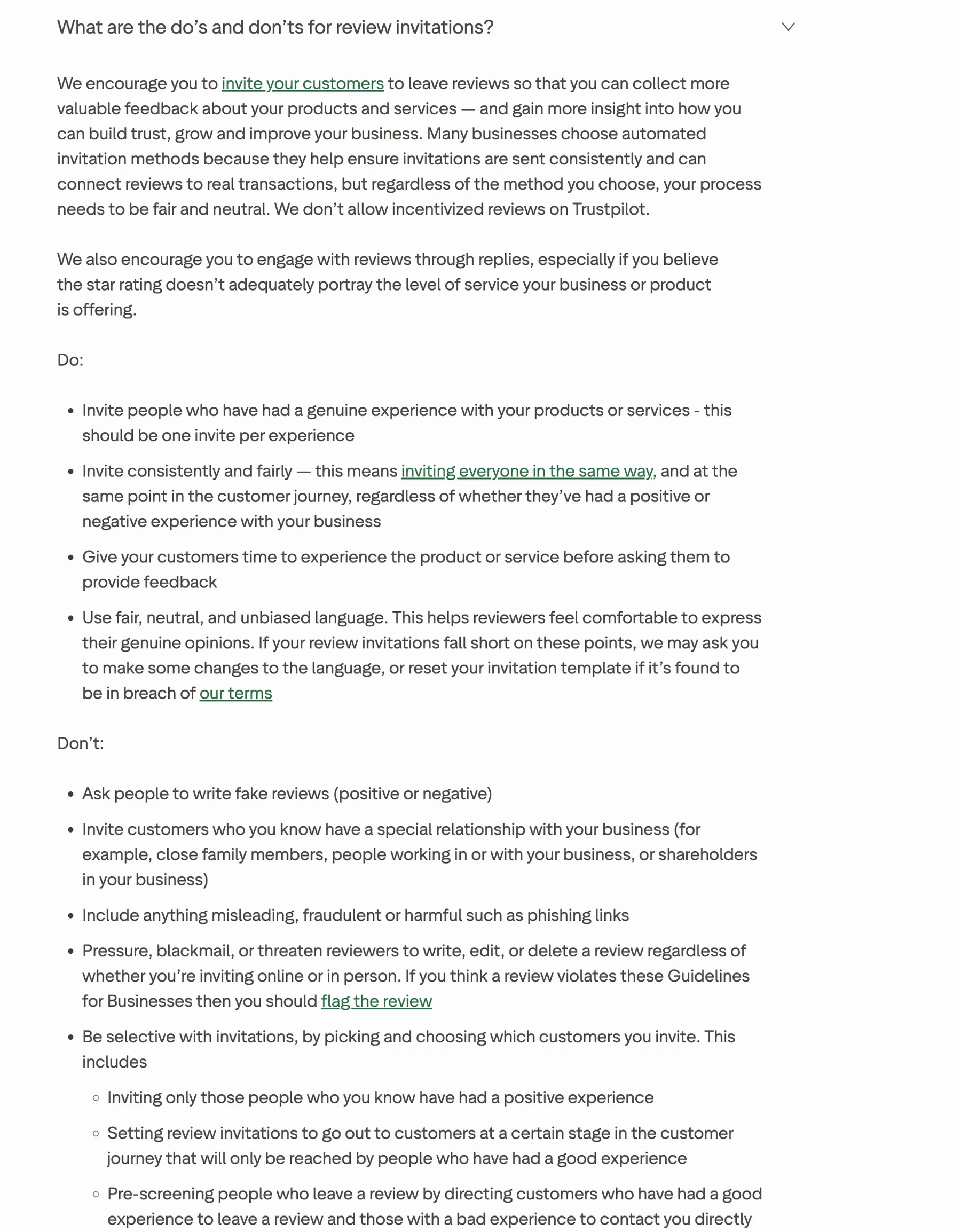
Google prohibits review gating (selectively asking happy customers for positive reviews) and offering incentives for posting any review. Yelp asks businesses not to request reviews at all. Trustpilot allows invitations but bans selective inviting and does not allow incentivized reviews, even if every customer gets the same offer.
United States
The FTC's Trade Regulation Rule on the Use of Consumer Reviews and Testimonials has been in force since October 21, 2024. It targets fake or false reviews, incentives conditioned on the review being positive or negative, and certain forms of review suppression, and courts can impose civil penalties for knowing violations. The rule does not ban every incentive, but failing to disclose one can still violate the FTC Act. The Consumer Review Fairness Act (2016) voids clauses in standard form contracts with consumers that restrict honest reviews.
European Union and UK
The Omnibus Directive (EU) 2019/2161 amended the Unfair Commercial Practices Directive. It bans fake reviews and requires businesses to say whether and how they check that reviews come from real customers. In the UK, the DMCC Act 2024 bans fake reviews and concealed incentivized reviews, with those rules in force since April 6, 2025.
UAE
Consumer protection and advertising rules apply, misleading endorsements carry risk, and paid promotion falls under media and advertiser licensing rules. Check the current rules with local counsel.
Can you offer a discount for a review? On Google, it breaks policy in every region. A disclosed incentive that doesn't depend on what the review says may be legal in some places, but it still breaks Google's and Trustpilot's rules. Don't do it. This is not legal advice, and the rules were current at publication (October 2026).
Reviews on your website: what schema still earns, and what is schema theatre
You won't get stars in Google for reviews of your own business. Since 2019, Google has not shown review rich results for self-serving reviews of LocalBusiness and Organization. Markup can still qualify on product pages, reviews of third-party things and critic reviews. Check Google's current review snippet documentation.
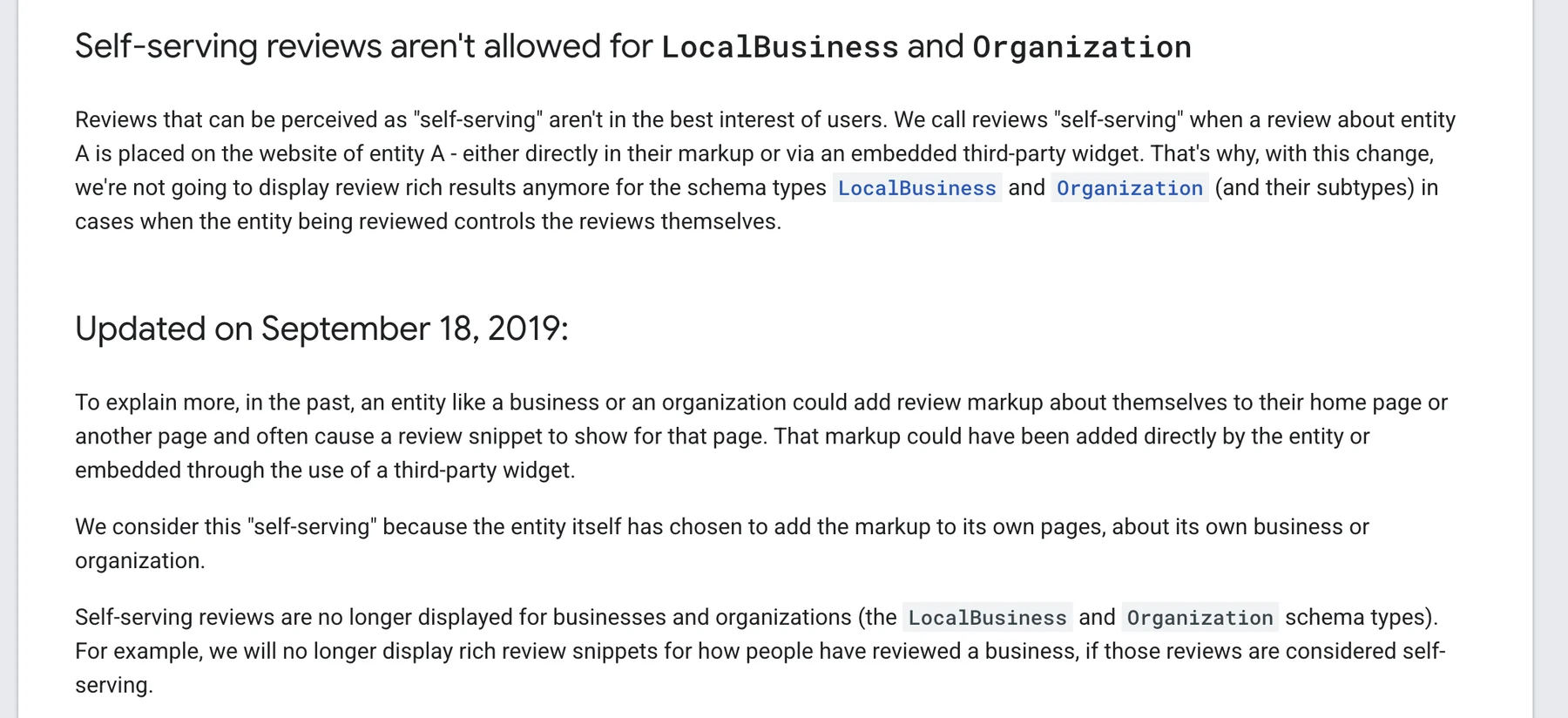
Schema theater looks like this: aggregateRating hard-coded on every page, ratings copied from Google, and widgets that inject markup. It earns no stars and adds policy risk. On-site reviews still help conversion and give Google and AI engines text they can crawl. Put a few detailed testimonials with service and location context on each service page. Use names only with permission, and link each one to its source platform.
Reviews and Google Ads: seller ratings, location assets and click-through rate
Reviews change how your ads look, which usually changes click-through rate. Seller ratings are an automated asset built from reviews on Google and approved third-party review partners. You need a minimum number of reviews and a minimum rating to qualify, so check the current thresholds in Google Ads Help. Location assets can show your Business Profile rating. In Local Services Ads (the US and some other markets), reviews affect ranking and appear in the ad. Details are on the Google Ads page.
How to measure the impact of reviews
Measure against a baseline you set before changing anything. Record review count, reviews in the last 90 days, rating and reply rate, for you and for the top 3 competitors.
Maps: GBP Performance and rank grids
GBP Performance shows searches, calls, website clicks and direction requests. Treat the numbers as a guide to trends, not exact counts. Add a monthly rank grid for 3-5 main service queries.
Leads: calls, direction requests, bookings
Use call tracking and record the source of every booked job, so you can link reviews to revenue, not only to visibility.
AI answers: tracking mentions and descriptions
Run a fixed set of prompts every month (“best [service] in [city]”, “who to hire for [job]”, “[brand] reviews”) in ChatGPT, Perplexity, AI Mode and AI Overviews, logged out where possible. Record whether you are named, your position, the attributes used and the sources cited. The AI visibility checklist gives you a structure for this.
Ads: CTR with and without ratings
Compare CTR between periods or campaigns with ratings showing and without them.
A 90-day review plan for a local or service business
| Period | Action | Owner | Metric |
|---|---|---|---|
| Days 1-14: baseline and fixes | Set the baseline, build the competitor sheet, claim and clean up 1-2 secondary platforms, reply to unanswered reviews from the last 6-12 months, fix GBP categories and services | Marketing lead | Baseline sheet complete |
| Days 15-45: build the request process | Set up the direct link, QR code and CRM or SMS trigger, write a staff script for asking in person, set a weekly target based on your real job volume and a reply time target | Operations | Requests sent, reviews per week, reply time |
| Days 46-75: content and secondary platforms | Use review language on service pages and in the GBP description, add testimonials to the site, start on the secondary platform that matters most in brand searches and AI answers | Marketing | Pages updated, secondary reviews |
| Days 76-90: measure and adjust | Rerun the rank grid, AI prompts, GBP Performance and Ads CTR, compare with the baseline and decide what to continue | Owner and marketing | Change against baseline |
FAQ
Do ChatGPT and Perplexity actually read Google reviews?
Neither documents it. ChatGPT gets local information through search providers and data partners, and in a 2026 BrightLocal study Yelp was its most cited source for local businesses. In practice, both cite pages they can retrieve: Yelp, Tripadvisor, Trustpilot, directories, lists and Reddit. Google's AI Overviews and AI Mode are closer to Google's own local data, with Business Profile as their main local source in the same study. Test with your own prompts and check the sources each one cites.
Why does Google AI Overviews recommend a competitor with fewer reviews than me?
Review count is only one input. The competitor may match the service and location wording better, appear on more cited third-party pages, have clearer categories, or have reviews that mention the exact attribute the user asked about.
How many reviews do I need to see an effect in the Map Pack or AI answers?
There is no universal number. Benchmark the top 3 businesses for your main query and area, match their last-12-month volume and keep a steady flow. Thin markets need far fewer reviews than competitive cities.
Does the average star rating matter more than the number of reviews?
Google says more reviews and positive ratings can help local ranking, without saying which weighs more. In our experience, once your rating looks credible, the number and recency of reviews compared with competitors tend to matter more for visibility. A low rating hurts conversion most: in BrightLocal's 2026 survey, 68% of US consumers said they would only use a business with four or more stars.
Do keywords in reviews help rankings, and can I ask customers to mention specific services?
Practitioners see a correlation, but Google has not confirmed it. Ask open questions such as “what did we help with?”, but never tell customers what to write or write reviews for them.
Does replying to reviews improve rankings or only conversions?
Google recommends replying, but the proven benefit is trust and conversion. Any direct ranking effect is unproven. Keep replies specific and human, and skip the keywords.
Is it legal to offer a discount for a review in the US, UAE or EU?
Google prohibits incentives for reviews everywhere, and so does Trustpilot. The US FTC rule bans incentives conditioned on the review being positive or negative, the EU and UK ban fake and concealed incentivized reviews, and UAE consumer protection rules apply. Don't offer anything for a Google review. This is not legal advice.
Will a sudden spike in reviews get my Google Business Profile filtered or suspended?
Unnatural bursts can lead to filtered reviews or a restricted profile, especially when the reviews come from new accounts or one location. Ask after every job instead of running one-off campaigns.
Do reviews on Yelp, Trustpilot or Clutch matter if most customers find me on Google?
They do little for Maps but often matter for AI answers and “[brand] reviews” searches. Pick 1-2 secondary platforms based on what ranks and what AI answers cite in your niche and region.
Can I add review schema to my website and get star ratings in Google?
Not for reviews of your own business. Since 2019, Google hasn't shown stars for self-serving LocalBusiness and Organization reviews. On-site testimonials still help conversion and give search engines text they can crawl.
How long does it take for new reviews to affect visibility?
Reviews usually go live within days after moderation. Effects on the Map Pack and AI answers build over weeks to months, and not evenly. Measure monthly with a rank grid and a fixed set of prompts.
Should I remove or report negative reviews, and when does Google take them down?
Report only reviews that break Google's policies: spam, conflict of interest, off-topic content, harassment or personal information. Google won't remove honest negative reviews. Reply calmly and fix the cause.
How do I track whether AI assistants mention my business and what they say?
Run a fixed list of prompts by service and city every month in ChatGPT, Perplexity, AI Mode and AI Overviews. Log whether you are named, your position, the attributes used and the sources cited. The free AI visibility checklist helps.
How 4Queries handles reviews across SEO, AEO, maps and Ads
4Queries treats reviews as one asset across all four places. That covers Business Profile and Maps work, review language on service pages (SEO), checking what AI assistants say and which sources they cite (AEO), and ratings in ads. The free express 4Queries audit shows where you appear in each place, who gets the client instead of you, and how your reviews compare with the businesses that rank. SEO, AEO or Google Ads cost $990 a month each. The full audit is $190, and the express audit is free.
What to do this week
- Write down your review count, last-90-day reviews, rating and reply rate, plus the same figures for the top 3 Map Pack competitors.
- Search “[your brand] reviews” and note which platforms rank.
- Ask ChatGPT, Perplexity and AI Mode for the best [service] in [city] and record what they say and which sources they cite.
- Reply to every unanswered review from the last six months.
- Set up the direct review link and choose who asks after each job.
If you want to see where you stand before changing anything, start with the free 4Queries audit.