
AEO vs SEO: the short answer
SEO gets your pages ranked and clicked in Google results. AEO (answer engine optimization) gets your business named, quoted or recommended inside AI answers from ChatGPT, Perplexity, Google AI Overviews and AI Mode. For a local or service business, both rest mostly on the same foundations: a site search engines can index, clear service pages, a strong Google Business Profile, and consistent reviews and mentions.
If your SEO is genuinely good, you already have most of the AEO groundwork. AEO adds three things: answer-first page formatting, off-site signals that AI tools read (reviews, directories, Reddit, local press), and a different way to measure results (repeated prompt sampling instead of rank tracking). Treat it as a layer on top of SEO, not a replacement.
By Dmitrii Dmitriev, in digital marketing since 2008, founder of KlientLab. Written for owners of local and service businesses in the US, UAE and Europe, not for marketers.
SEO, AEO, GEO, LLMO: plain-language definitions
SEO is the work that helps Google and Bing find, understand and rank your pages so people click through to your site. AEO is the work that makes AI assistants and AI search features name your business and pass on accurate facts about it. GEO (generative engine optimization) and LLMO (large language model optimization) are other labels for largely the same work. GEO comes from a 2023 research paper (Aggarwal et al., arXiv 2311.09735, accepted at KDD 2024); AEO and LLMO are industry terms with no single documented origin. You do not need to choose between them.
Why 'SEO vs AEO' is the wrong question: the four places a customer looks for you
SEO and AEO are two of the four places a customer looks for you, not rival schools of thought. The useful question is which gap costs you the most leads right now.
One customer, four searches before they call
A typical service buyer searches Google, asks ChatGPT or reads an AI Overview, checks the map pack and reviews, then clicks an ad or calls. Four places: Google Search (SEO), AI answers (AEO), maps and reviews (Google Business Profile, ratings) and Google Ads. The 4Queries method treats them as one system.
What happens when you're missing from one of them
An illustrative scenario, not a real client: a dental clinic ranks well for “dentist in [city]”, but ChatGPT names three other clinics with more recent reviews and directory listings. The clinic's SEO is fine. Its gap is AI answers and reviews, so that is where the next dollar should go.
What SEO and AEO share: the foundations you build once
Most of the work serves both channels. Fix these once and you improve rankings and AI answers together:
- Indexable, fast, crawlable site. AI tools that search the web rely on search indexes, so an unindexed page is invisible to both.
- One clear page per service and per location, with no thin or duplicate pages.
- Entity clarity: the same name, address, phone, categories and services everywhere, so your mentions read as one business.
- Authority and trust: real reviews, local and industry mentions, named experts with credentials (critical in healthcare, legal and finance).
- Structured data that matches the visible page: LocalBusiness, Service, FAQ where appropriate.
What is genuinely different between AEO and SEO
The real differences are in query shape, sources and measurement. |
| SEO | AEO | |
|---|---|---|
| Query | Short keywords | Full questions with conditions (“near me, open Sunday, speaks Arabic”) |
| Output | Ten links plus a map pack | One answer naming a short list (a median of 2 to 4 businesses in a 2026 BrightLocal study), sometimes none |
| Sources | Your pages and links | Your pages plus reviews, directories, forums, press, training data |
| Stability | Rankings move slowly | Answers vary between runs |
| Measurement | Rank, clicks, Search Console | Mention rate over repeated prompts, AI referrals, leads |
| Time to effect | Months for competitive terms | Weeks for fact fixes, months for recommendations |
| Direct control | High (your site) | Lower (third parties matter) |
The biggest practical difference: AEO rewards what other people say about you more than what your own site says. And there is no stable “position 1” in AI answers: in a 2026 BrightLocal study of local searches, result sets for the same prompt overlapped by only 20 to 33% on average between runs. Anyone selling guaranteed AI rankings is overpromising.
Where AI answers get their information for local and service queries
Local AI answers draw on search indexes, Business Profile and review data, directories, forums and training data, in a mix that differs by platform.
Search indexes: Google and Bing
AI Overviews and AI Mode use Google's index. OpenAI says ChatGPT search uses third-party search providers plus partner content; its help pages name Microsoft among those providers, and its Enterprise and Edu documentation names Bing. OpenAI does not publish the full mix. Perplexity runs its own retrieval and shows citations.
Google Business Profile and review platforms
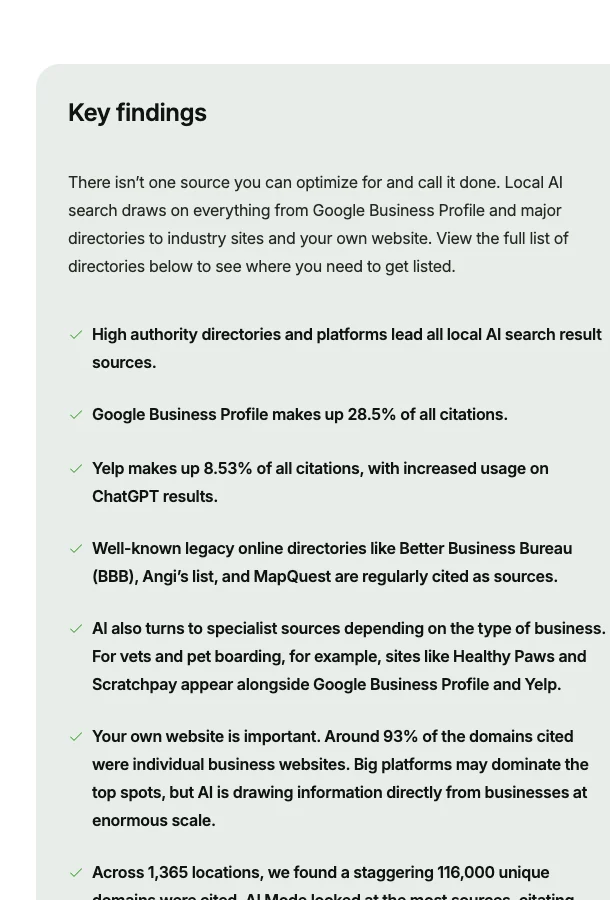
Google tells businesses to keep their Business Profile information up to date for its AI features, and in a 2026 BrightLocal study of local queries in the US, UK and Australia, Business Profile was the main source AI Overviews and AI Mode used for local businesses. Reviews on Google, Yelp, Tripadvisor, Trustpilot and sector platforms, and their recency, often appear as reasons for a recommendation.
Directories and industry listings
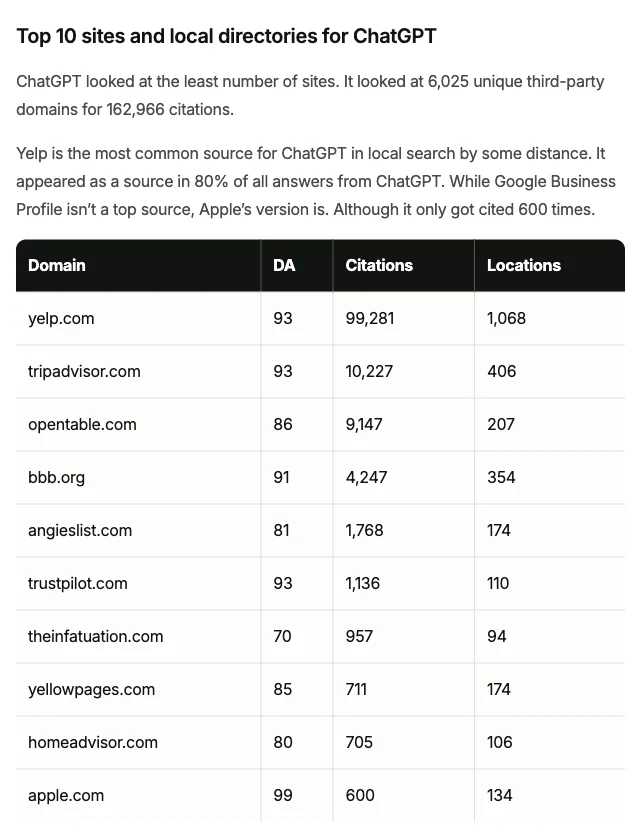
In the US, a 2026 BrightLocal study found Yelp, BBB and Angi among the directories AI search regularly cites for local businesses. We have not seen comparable data for the UAE or Europe, so check whether portals such as Bayut or Dubizzle, or platforms such as Doctolib, are actually cited in your niche.
Reddit, forums and local press
“Who's good for X in Y” threads and local news are cited often.
The model's own training data
Without searching, an assistant answers from training data that may be months old. To see which sources matter in your niche, read the citations Perplexity and AI Mode show.
ChatGPT vs Perplexity vs Google AI Overviews vs AI Mode: what each one tends to reward
Each platform leans on different sources. These are observed tendencies as of late 2026, not documented algorithms. |
| Platform | Searches and cites | Seems to lean on | You can influence |
|---|---|---|---|
| ChatGPT | Only when it searches; may show place cards | Third-party search, partner data, training data | Consistent mentions across the web |
| Perplexity | Always | Structured pages, recent content, third-party lists | Clear pages, presence in lists |
| AI Overviews | On some queries, above organic results | Google's index; overlaps with pages that rank | Your SEO |
| AI Mode | Yes, with follow-ups | Business Profile and reviews for local queries | GBP and reviews |
Copilot fetches web results from Bing when web search is on, and Gemini can use public information from Google services, including Google Search and Google Maps.
Run a 15-minute check: do AI assistants recommend your business?
You can see in 15 minutes whether AI assistants recommend you, using five prompts and three platforms.
Step 1: Write five prompts the way your customers would ask
For example: “Best [service] in [city] for [specific need]”, “Who should I call for [urgent problem] in [area] on a weekend?”, “[Your brand] reviews: is it reliable?”, “[Your brand] vs [competitor]”, “How much does [service] cost in [city]?”
Step 2: Run each prompt in ChatGPT, Perplexity and Google AI Mode in a logged-out or private window
Step 3: Repeat each prompt three times and note who gets named
Answers change because generation has some randomness, retrieval differs between runs, and location and personalization vary. Score yourself as named in X of 9 runs per prompt.
Step 4: Record the sources cited and which competitors appear
Step 5: Check that the facts about you are correct
Red flags: wrong prices, an old address, a closed location, a competitor described with your strengths.
The complete 19-question method is in the free AI visibility checklist.
How to build pages that work for both Google and AI answers
Pages that work for both state the answer first and contain facts that can be quoted. The full on-site scope is on our SEO page.
Answer-first service pages
Open with two or three sentences: what you do, for whom, where, from what price, how fast. Add quotable facts: service area, languages, licenses, years in business, warranty terms.
FAQ written from real customer questions
Build FAQs from real calls, emails and reviews, not keyword tools.
Schema that matches the page
LocalBusiness or ProfessionalService, Service, FAQPage, Person for named experts. Schema helps machines read the page; it does not get you cited on its own.
Real prices, locations, hours and dates
AI answers to “how much” questions often quote whoever publishes a number. Show an honest “last updated” date. One location means one real page with local proof (team, photos, reviews), never a doorway page.
Off-site work that actually moves AI answers
Off-site signals are where AEO adds the most new work compared with classic SEO.
Google Business Profile
Correct primary category, every service listed, accurate hours, photos, posts, and attributes such as languages and accessibility.
Review volume, recency and content
A steady flow beats a one-off burst. Reviews that mention the service and area give AI tools something concrete to repeat. Never buy or gate reviews; platforms penalize both.
Directories and identity consistency
Choose the few directories that matter in your niche, use an identical name, address and phone, and remove duplicates and old addresses.
Local press, associations and community mentions
Local news, chambers of commerce, associations, sponsorships and genuinely helpful forum answers. This is why a small business can beat big brands on local queries: local signals outweigh national size.
US vs UAE vs Europe: what changes by market
The principles are the same everywhere; platforms, languages and rules differ. AI Overviews and AI Mode availability varies by country and language, so check your market on the date you read this.
| US | UAE | Europe | |
|---|---|---|---|
| Reviews, directories | Google, Yelp, BBB, Angi | Google, portals, sector listings | Google, Trustpilot, national directories |
| Language | English | English and Arabic | Local languages |
| Rules | Health and finance ad rules | Health and finance ad rules | GDPR and tracking consent |
| Behavior | Most competitive review ecosystem | WhatsApp-first; areas named by community (JLT, Business Bay) | Consent mode means less AI referral data |
When to prioritize SEO, when AEO, and when both
Prioritize the gap that costs you the most leads now.
| Situation | Focus | Why |
|---|---|---|
| New site, little indexed | SEO foundations | AEO has nothing to stand on |
| Ranks well, AI names competitors | Add AEO | Off-site signals are the gap |
| Weak GBP, few reviews | Maps and reviews | Feeds local SEO and AI answers |
| Clinics, legal, B2B | Both | Trust content and named experts |
| Need leads this month | Google Ads alongside | Neither SEO nor AEO is fast |
| Small budget | Shared foundations | They pay off everywhere |
Budget and timeline: what you can do yourself and what needs a specialist
Much of the groundwork is do-it-yourself; specialists pay off on technical work, sources and measurement.
Do it yourself
The 15-minute check, GBP cleanup, a review-request routine, consistent name, address and phone in main directories, honest prices and FAQs.
Where a specialist pays off
Indexing issues, site structure, schema, source targeting, outreach and measurement. At 4Queries, SEO, AEO or Google Ads is $990 a month per channel, the full audit $190, the express audit free. Monthly scope is on the AEO page.
When to expect results
Estimates from our own projects, not promises: fact and listing fixes can appear within weeks as tools re-crawl; competitive recommendations and rankings usually take months.
How to measure AEO honestly
Measure mention rate, accuracy and leads, not rank, and expect every method to undercount.
Repeated prompt sampling
Run a fixed prompt set monthly, several runs per platform.
AI referral traffic in GA4
Create a channel group for chatgpt.com, perplexity.ai, copilot.microsoft.com and gemini.google.com. Much AI-influenced traffic arrives as direct or branded search. AI Overviews and AI Mode clicks sit inside Search Console data, not split out cleanly.
Calls, forms and WhatsApp leads
Use call tracking and a “How did you find us?” field with an AI assistant option. Watch branded search growth.
Asking customers
Ask on the phone. Judge AI Overviews by calls and leads, not sessions.
Common mistakes and what not to pay for
Most wasted AEO money goes on promises nobody can keep. Do not pay for:
- “Guaranteed placement in ChatGPT”
- Mass AI-written articles with no first-hand experience
- Schema-only “AEO packages”
- llms.txt sold as a ranking fix (at best a minor, unproven signal)
- Fake reviews or review gating
- Rank tracking dashboards sold as AEO reporting
- Location pages for areas you do not serve
And do not switch off Google Ads overnight because “AI is taking over”. Judge each channel by cost per lead.
AEO vs SEO: frequently asked questions
Do I need to do AEO separately if my SEO is already good?
Not always. Good SEO covers most of the groundwork. Run the 15-minute check: if AI answers name competitors or get your facts wrong, add AEO work on reviews, directories, mentions and answer-first pages. If they already name you correctly, keep monitoring monthly.
Does ChatGPT use Google or Bing results when it recommends a local business?
OpenAI says ChatGPT search uses third-party search providers and partner content. Its help pages name Microsoft among those providers, and its Enterprise and Edu documentation names Bing; OpenAI does not publish the full list. Google AI Overviews and AI Mode use Google's index, and for local queries they lean heavily on Business Profile data. Cover both, including Bing Places and Bing Webmaster Tools.
How do I find out whether ChatGPT or Perplexity recommends my business, and why do the answers change each time?
Run a fixed set of customer-style prompts in private windows and repeat each several times. Answers vary because generation is probabilistic, retrieval differs between runs, and location and personalization change. Track how often you are named. The AI visibility checklist has the full method.
Do Google Business Profile reviews affect whether AI assistants mention me?
For local queries, in practice yes. Google tells businesses to keep Business Profile information current for its AI features, and a 2026 BrightLocal study found Business Profile was the main source for AI Overviews and AI Mode on local queries. Other assistants often cite review platforms; in the same study, Yelp was ChatGPT's most cited source. Volume, recency and specific details about the service and area all help. No platform publishes an exact weight.
How long does AEO take to show results compared with SEO?
In our experience, corrections to listings and facts can show up within weeks as AI tools re-crawl. Earning recommendations for competitive queries usually takes months, as with SEO. Both are estimates that depend on niche, market, starting point and competitors.
Can a small local business compete with big brands in AI answers?
For local and service queries, often yes. Proximity, local reviews, a complete Business Profile and local mentions matter more than national brand size. For broad, non-local questions, big brands have the advantage, so put local signals first.
Does AI Overviews reduce calls and leads for service businesses, or just clicks?
Informational clicks can fall. Calls and leads depend on whether you are named and how visible your Business Profile and call button are. Measure calls and leads, not sessions, before concluding that AI Overviews hurt your business.
Is schema markup enough to get cited in AI answers?
No. Schema helps machines read your page accurately, but citations depend on content quality, indexing and what third parties say about you. Treat schema as hygiene every service page should have, not as a strategy.
Should I stop paying for Google Ads if AI answers are taking over?
Not by default. Ads still capture high-intent searches immediately, while SEO and AEO take months. Compare cost per lead across channels using your own data and shift budget gradually toward whatever produces leads more cheaply.
How do I track leads that came from ChatGPT or Perplexity?
Use a GA4 channel group for AI referrers, call tracking, a “How did you find us?” field with an AI assistant option, and a question on the phone. Expect undercounting, because many AI-influenced visits arrive as direct or branded search.
Is AEO the same as GEO or LLMO, or is that just new labels for the same work?
Mostly new labels for overlapping work: getting a business found and described accurately in AI-generated answers. GEO was introduced in a 2023 research paper; AEO and LLMO are industry labels with no single documented origin. Judge the specific work, deliverables and measurement being offered, not the acronym.
What does AEO cost, and what part of it can I do myself?
You can run the visibility check, clean up your Business Profile, ask for reviews and fix directory listings yourself. Specialists cover technical work, source strategy, outreach and measurement. At 4Queries: $990 a month per channel, $190 full audit, free express audit.
Does AEO work differently in the UAE or Europe than in the US?
The principles are the same. AI feature availability, languages (Arabic in the UAE, local languages across the EU), review platforms, contact channels such as WhatsApp, and consent rules such as GDPR all differ. Check feature availability in your market.
Next step: see where you show up in all four places
If you would rather not run the check yourself, the free express 4Queries audit shows your visibility in Google Search, AI answers, maps and reviews, and Ads. The $190 full audit adds a written report with gaps ranked by impact on leads for your market (US, UAE, UK or EU). Monthly work, if needed, is $990 a month per channel: SEO, AEO or Google Ads. Prefer to start alone? Use the AI visibility checklist.
What to do this week
- Run the five-prompt check in ChatGPT, Perplexity and AI Mode, three runs each.
- Fix any wrong facts in your Google Business Profile and top three directories.
- Start a weekly routine of asking recent customers for reviews.
- Rewrite the opening of your main service page answer-first, with a price range.
- Add an AI assistant option to “How did you find us?”
To see all four places at once, request the free express 4Queries audit.